
Smart robots make their way into Flemish carrot fields
A robot that drives autonomously across a carrot field, recognises plants and then removes weeds without touching the crop: what sounded futuristic just a few years ago is now being applied on Flemish demonstration fields. At Inagro in Roeselare, researchers are examining how artificial intelligence in autonomous robots can make vegetable production more precise, efficient and sustainable. “Robots in a vegetable field are no longer science fiction,” says Eva Ampe, research lead for precision agriculture at Inagro. “We test robots that are already available today and investigate what they can really mean for growers in practice. This means farmers do not have to be the first to step into the unknown themselves.”
The potential is particularly significant in fine-seeded crops such as carrots, onions, parsnips and chicory. Young plants in these crops are very vulnerable, which means that conventional early mechanical weeding is not always possible. At the same time, growers are looking for ways to control weeds more efficiently, with less labour pressure and increasingly precise techniques.
Research lead Eva Ampe explains: “With carrots or onions, you cannot simply drive across the field with a harrow. The seedlings are too fragile for that. You would damage or pull out the crop as well. That is precisely where robots can make a difference in the long term, because they learn plant by plant where they can and cannot intervene.”
Grippers, small hoes and soon lasers too
Two autonomous weeding robots are currently operating on Inagro’s demonstration fields, in conditions that closely match the day-to-day reality of vegetable growers. The Dutch Odd.bot Maverick uses small mechanical grippers to pull weeds from the soil. The robot drives autonomously between the rows and navigates using camera images, without GPS. Since early May, Inagro has also been testing the Swedish Ekobot WEAI from the company Homburg, which removes weeds with small U-shaped hoes and uses GPS guidance.
In August, a third technology will be added: a laser robot, Trabotix, which destroys the growing points of young weeds with a targeted laser beam. “Laser weeding sounds spectacular, but here too we mainly want to take a realistic look,” says Ampe. “What works in our crops? Under what conditions? And for which farms can it really add value? That is what we are trying to map out step by step.”
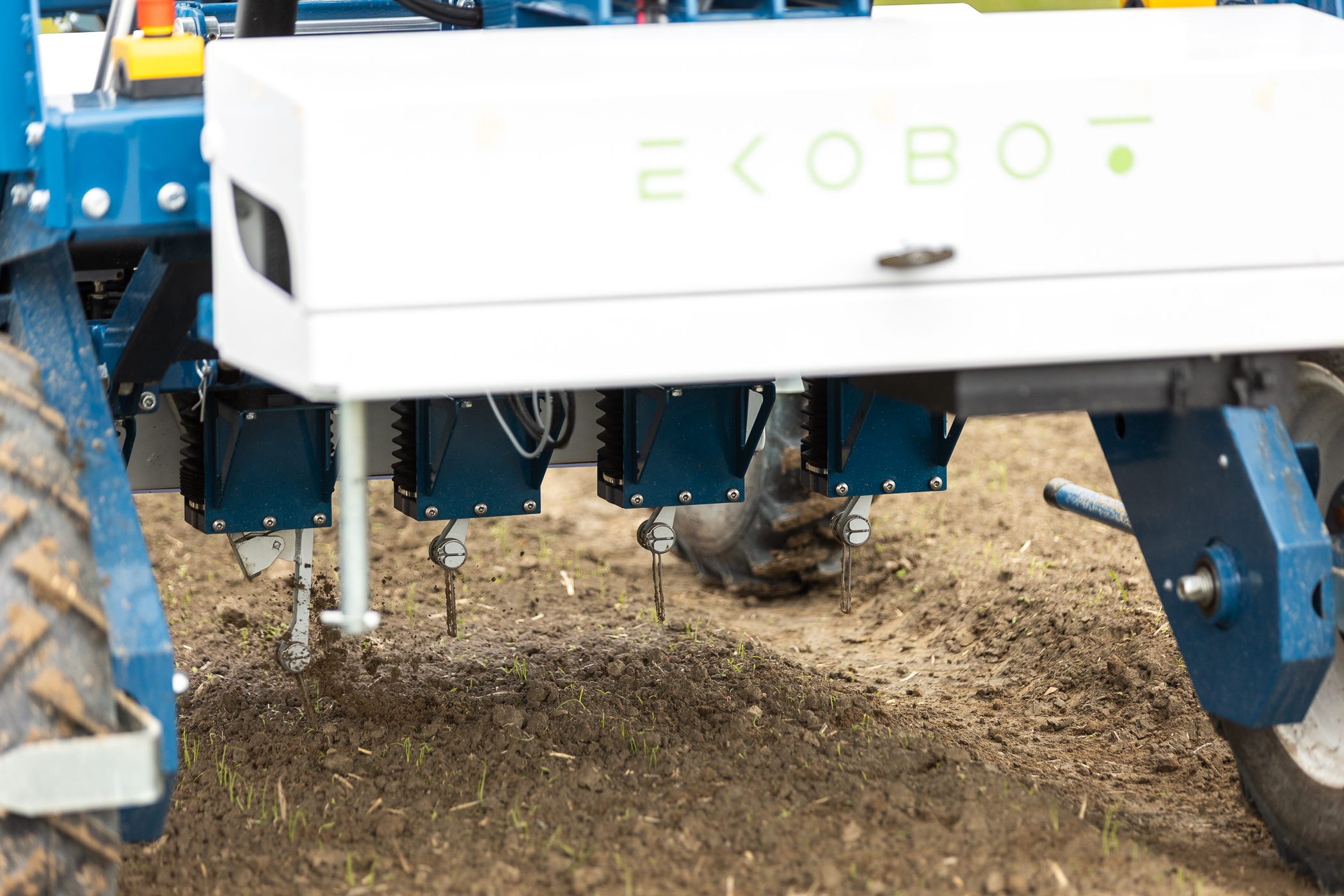
Ekobot
Innovation driven by practice
The practical tests at Inagro start from concrete questions raised by growers. They want to know which technology works in Flemish conditions, on plots that are often smaller than in some neighbouring countries. “We are not testing gadgets, but machines that are commercially available today. Growers rightly want to know what such a robot can do, where the limitations are and how much surface area is needed to make the investment worthwhile.” In Flanders, adoption is still in its early stages, but interest is growing. In the Netherlands, around 25 robots are already in use, mainly in organic vegetable production on larger plots.
The weeding robots are part of a broader shift towards precision agriculture. Cameras, data and AI help growers intervene at the right time and in the right place. This can be done mechanically, as with robots that pull out or scrape away weeds, but also through other techniques such as ultra-targeted herbicide application on just a few square centimetres. This “ultra-local spot spraying” is already easily accessible to growers through contract work.
This precision is also relevant in the broader context of crop protection. In certain crops, mechanical weeding can help reduce the number of herbicide treatments. At the same time, nuance remains important: the robots target weeds and are not a solution for everything. “It is not a miracle cure,” Ampe emphasises. “They do not replace all crop protection and, for example, do not address insect infestations. Persistent grasses also remain a challenge. But for weed management, they can become an important tool.”
Not a replacement for the farmer
Labour also remains an important point of attention. In organic crops, a robot can take over a large part of manual weeding. In conventional crops, it can mainly help keep weeds under control at an early stage, for example in onions, where conventional weed management is becoming more difficult due to the disappearance of specific products. If weeds remain later in the crop cycle, other precision techniques such as ultra-local spraying can play a role.
“The robot does not replace the farmer,” says Eva Ampe. “You should see it as an additional tool on the farm: one that can take over very precise work at times when this currently requires a lot of labour or is becoming more difficult with conventional techniques. But farming will always remain a combination of technology, professional knowledge and practical experience.”
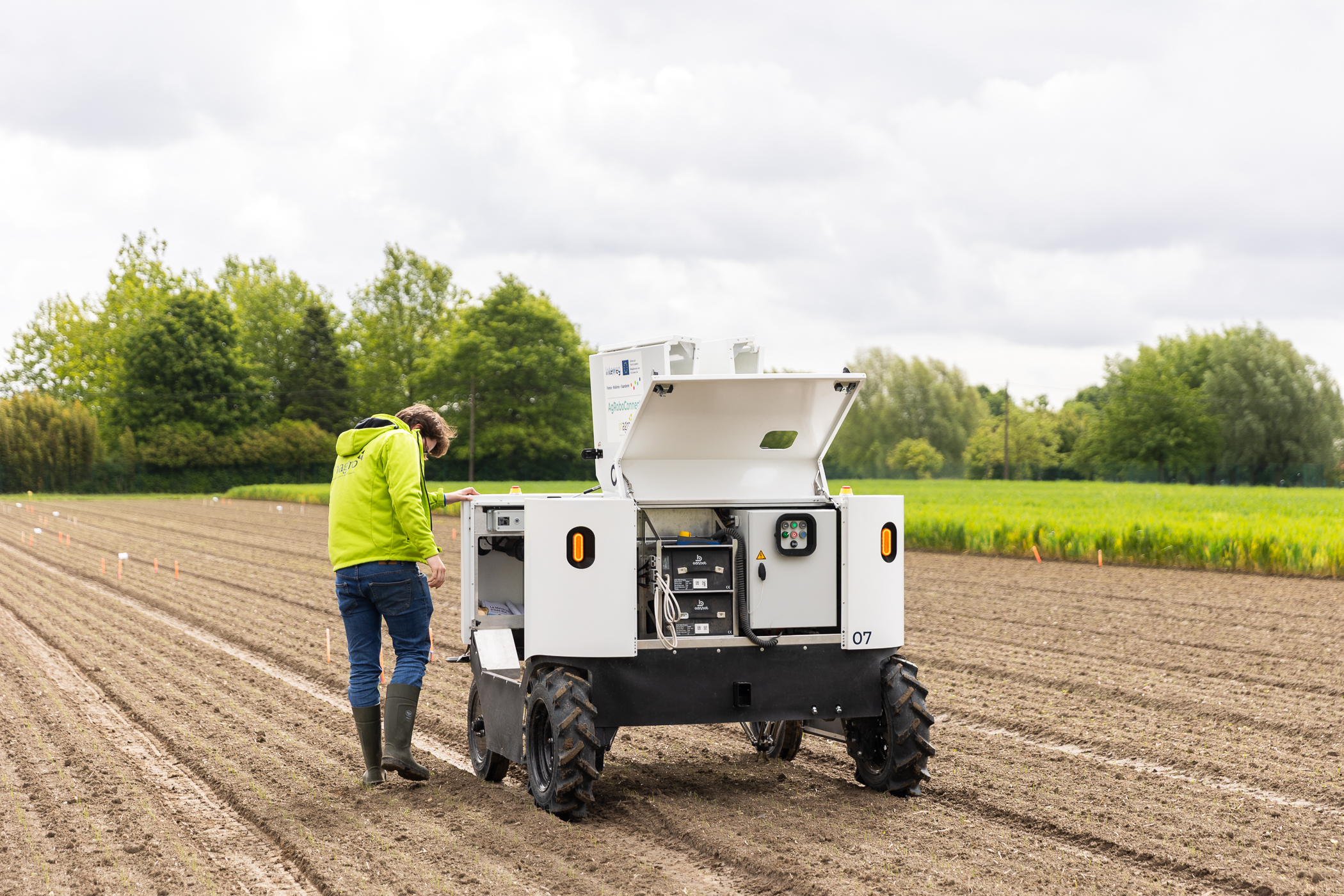
Weeding robot and Inagro employee
Cost also plays a role. Purchasing such a robot requires a substantial investment. That is why Inagro is not only examining technical performance, but also practical and economic feasibility: how many hectares are needed, how much labour can be saved and in which crops does the system pay off most?
Tomorrow’s vegetables
For consumers, seeing such a robot in the field may still be surprising. Yet the technology says a lot about how Flemish vegetable production is evolving. Behind local carrots, chicory, onions and parsnips, there is increasingly high-tech knowledge: GPS-guided precision seeders, cameras that recognise plants, algorithms that learn and machines that perform precision work centimetre by centimetre.
“The technology is evolving quickly, but the basis remains the same. We want to help growers continue producing high-quality vegetables in a way that is feasible for the farm and suited to the challenges of tomorrow,” Ampe concludes. What is being applied today among carrots and onions on demonstration fields in Roeselare may therefore shape the image of even more sustainable vegetable production in Flanders tomorrow.


Funded by the European Union. However, the views and opinions expressed are solely those of the author(s) and do not necessarily reflect those of the European Union or the European Research Executive Agency (REA). Neither the European Union nor the granting authority can be held responsible for them.