
CARBON STORAGE – Fruit Orchards as Important Above- and Below-Ground Carbon Sinks
Fruit trees are widely recognised for their role as natural air filters and oxygen producers. Through photosynthesis, they absorb carbon dioxide (CO₂) from the atmosphere and release oxygen.
But how much carbon is actually stored both above and below ground in fruit orchards? Researchers at the Flanders Research Institute for Agriculture, Fisheries and Food (ILVO) set out to answer this question. Through extensive field measurements, they investigated net carbon storage in both the soil and the woody biomass of orchard trees.
The study was carried out in twelve low-stem orchards across Flanders, including nine pear orchards (Conference) and three apple orchards. Nine sites were located in Deinze (East Flanders) and three in Asse (Flemish Brabant). The orchards, planted on sandy loam and loam soils, ranged in age from 9 to 70 years, with planting densities varying between 1,400 and 3,000 trees per hectare.
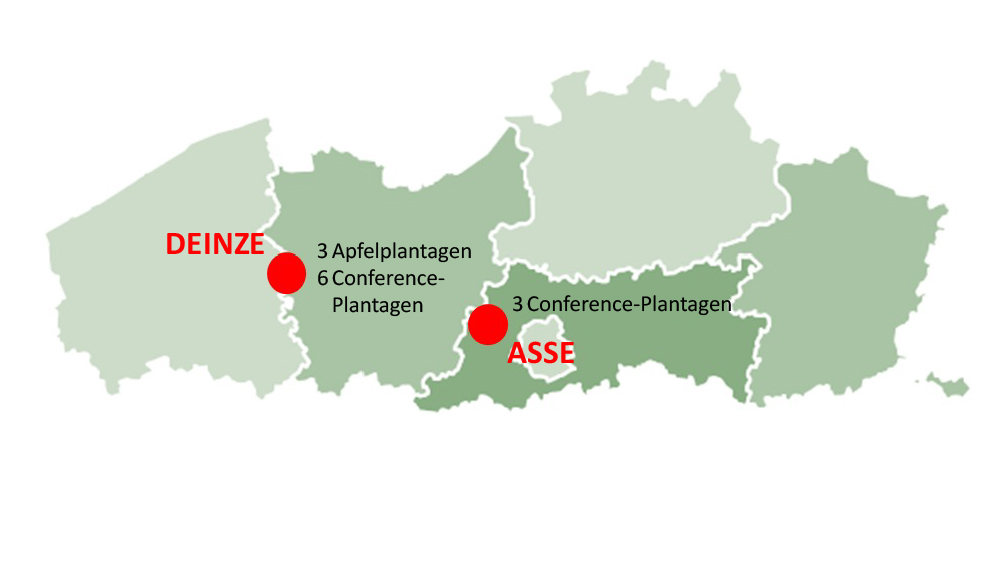
Sampled orchards in Deinze and Asse.
Foto: © ILVO
Carbon storage in the soil:
To assess below-ground carbon storage, soil samples were collected from both the grass strips and the tree rows at three depths: 0–30 cm, 30–60 cm and 60–90 cm.
In the upper soil layer (0–30 cm), both the soil carbon concentration and the carbon stock were found to be significantly influenced by the age of the trees.
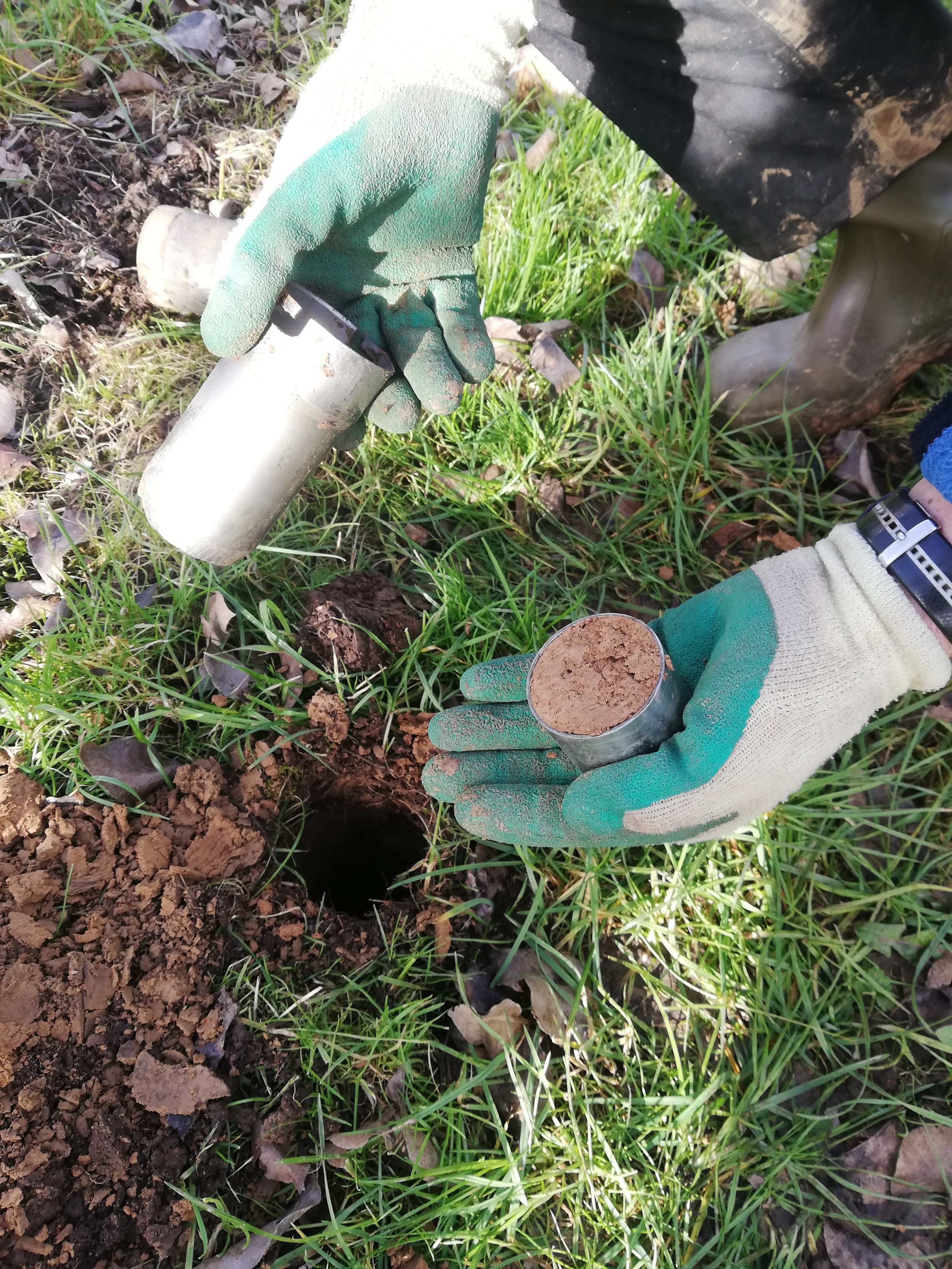
Soil sampling in the orchards.
Foto: © ILVO
The grass strips contained higher carbon stocks than the tree rows. This can be attributed to the permanent ground cover and the continuous input of organic matter through roots, root exudates, grass residues and the application of farmyard manure.

Higher below-ground carbon stocks were measured in the grass strips than in the tree rows.
Foto: © ILVO
No significant differences were found between apple and pear orchards. In the deeper soil layers (30–60 cm and 60–90 cm), neither orchard age nor strip type had a marked influence on soil carbon content. Carbon concentrations and carbon stocks at these depths were considerably lower than in the topsoil.
Compared with earlier measurements carried out in 2012, the 2022 survey recorded an average increase of 2.1 tonnes of carbon per hectare per year, mainly in the upper soil layer (0–23 cm).
Carbon storage in woody biomass
The average carbon stock in the above-ground woody biomass of the surveyed orchards amounted to 17.12 tonnes per hectare. When the root system is included, this increases to 21.49 tonnes per hectare.
Annual carbon sequestration was estimated at 0.43 tonnes per hectare without roots and 0.54 tonnes per hectare when the root system is included. These findings clearly demonstrate the important role of woody crops in long-term carbon storage.

Assessing carbon storage in woody biomass.
Foto: © ILVO
Tree age proved to be a significant factor. Older trees stored substantially more carbon in their biomass than younger trees, following an almost linear relationship. By contrast, no major differences were observed between apple and pear trees.
When orchards are removed, relocated or replanted, every effort should therefore be made to preserve as much of the accumulated carbon stock as possible. This can be achieved by minimising soil disturbance and by making sustainable use of the harvested wood, for example in long-life wood products or as a renewable energy source.
Conclusion
Fruit orchards are important above- and below-ground carbon sinks. Annual carbon sequestration in low-stem orchards ranges from 0.43 to 0.69 tonnes of carbon per hectare in woody biomass and from 0.65 to approximately 2 tonnes of carbon per hectare in the soil. This corresponds to approximately 1.6–2.5 tonnes and 2.4–7.3 tonnes of CO₂, respectively.
Compared with land without woody vegetation, fruit orchards have considerable potential to capture carbon every year while preserving substantial long-term carbon stocks.
Increasing soil carbon levels not only contributes to climate change mitigation but also improves soil fertility, nutrient availability, water retention capacity, soil aggregation and structure, microbial activity, and ultimately crop productivity.

Fruit trees are important carbon sinks
Foto: © ILVO
More information: www.wirpackennachhaltigkeitan.eu


Co-funded by the European Union.
The views and opinions expressed are those of the authors only and do not necessarily reflect those of the European Union or the European Research Executive Agency (REA). Neither the European Union nor the granting authority can be held responsible for them.