First in the vegetable aisle: mushrooms get packaging made from their own residual stream
Mushrooms packaged in the very raw material they grew on: it sounds almost too good to be true. And yet it is happening. In Adegem, Compack, the start-up founded by mushroom grower Marie-Elise Cannie and her family, has developed a circular punnet based on spent mushroom substrate. Since mid-May, the first organic mushrooms in this packaging have been available in stores. It is a striking first, with potential far beyond the mushroom sector.
Marie-Elise Cannie literally grew up among mushrooms. Today, together with her family, she helps run the family-owned Archiduc mushroom farm in Adegem. “Innovation is essential in our sector,” she says. “We work with natural processes and residual streams, but there is still a lot of untapped potential there.”
The idea for the packaging emerged eight years ago from a simple question: what can we do with spent mushroom substrate, the growing medium left over after mushrooms are harvested? “Today, this residual stream is often removed from the farm, and that costs money. Yet it is actually a valuable material. We thought: couldn’t we use it more intelligently?”

Spent mushroom substrate is the growing medium left over after mushroom harvesting. This residual stream turns out to be a valuable material: by mixing the substrate with paper pulp, a sturdy material is created that is suitable for packaging.
The answer proved surprisingly concrete. By mixing spent mushroom substrate with paper pulp, a strong and mouldable material is created that can be used for packaging. In this way, mushrooms are literally given a box made from their own growing medium. “It is a beautiful circular story. The mushrooms are packaged in the raw material in which they have grown throughout their entire life. The packaging is also fully recyclable through the paper and cardboard stream, making it practically easy for consumers as well.”
Sustainable and feasible
To develop the concept further, the start-up Compack was founded three years ago. The road to a market-ready product proved intensive. “There is much more involved than you might think at first glance. Food safety is crucial, but so are strength, moisture resistance and recyclability. Especially with mushrooms, which are sensitive to moisture and can spoil quickly.”
That is precisely why the team deliberately started with mushrooms. “If it works for this crop, then it can also work for other vegetables and fruit.” After years of testing and fine-tuning, the first phase has now been completed. Recently, the first organic mushrooms from the farm have been available in supermarkets in the new packaging.
An important ambition was to develop not only a sustainable alternative, but also an affordable one. “For us, it was important that the price difference compared with existing packaging remains limited,” Marie-Elise Cannie explains. “We want this to be feasible for growers and accessible to consumers.” Because the raw material comes directly from the farm and is reused locally, costs remain under control. The result is already close to the price of a traditional plastic punnet.
Looking to the future
Although the first application focuses on mushrooms, Compack sees much broader possibilities. “This is only the beginning. We are also considering applications for soft fruit such as berries or grapes, or for other vegetables. Different shapes can be made, allowing us to respond to what the market needs.” Interest from the sector is growing, but the team has chosen to first gain its own experience. “We want to have everything fully fine-tuned before scaling up further. But the potential is significant.”
Today, the packaging is produced using spent mushroom substrate from the company’s own farm. In the longer term, however, Compack sees clear opportunities to scale up this model and involve other mushroom growers as well.
The story of Compack shows how innovation in the Flemish vegetable sector often emerges from practice itself. It is driven by product knowledge, but also by perseverance. “It has been a long journey, with trial and error. But it is incredibly motivating to see that you can turn a residual stream into a fully fledged product. And that, in doing so, we are helping to build a more circular future.”
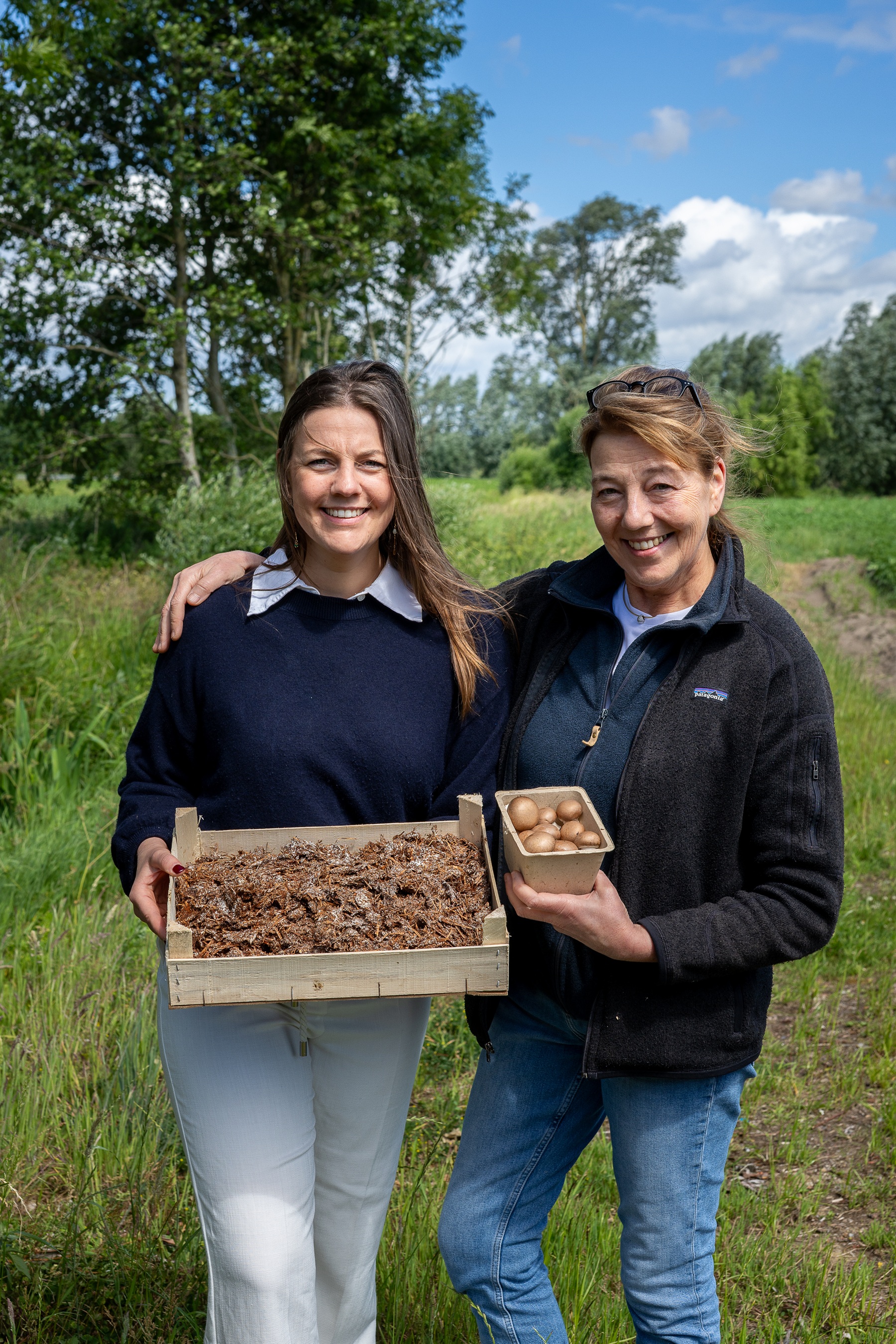
Marie-Elise Cannie grew up among mushrooms. Today, together with her family, she helps run the family-owned Archiduc mushroom farm in Adegem.


Funded by the European Union. However, the views and opinions expressed are solely those of the author(s) and do not necessarily reflect those of the European Union or the European Research Executive Agency (REA). Neither the European Union nor the granting authority can be held responsible for them.